Verb Kingdom
A gamified English learning experience — where grammar becomes a problem to solve.
一个游戏化的英语学习体验——让语法变成一个需要解决的问题。
At a glance
项目概览
Independent project — designed, developed, deployed and published by Yilin Wu / Yiklam Studio.
独立项目 — 由 Yilin Wu / Yiklam Studio 独立设计、开发、部署并上线。
Why grammar rules alone don't stick
为什么单纯讲语法规则不够
Young learners often confuse verb-to-be with action verbs. Telling them “am/is/are are be-verbs; run/eat are action verbs” is correct, but it rarely transfers into sentence-level writing.
低龄学习者常把 be 动词 和 行为动词 混淆。直接告诉他们“am/is/are 是 be 动词;run/eat 是行为动词”虽然正确,却很难迁移到句子写作中。
The real problem is not memorising labels. It is recognising what a sentence “driver” is, spotting when a sentence has too many drivers, and knowing how to fix it.
真正的问题不是记住标签,而是识别句子的“驱动词”,发现一句中出现多个驱动词,并知道如何修正。
FROM THE MODULE
One sentence,
ONE driver.
A sentence needs one verb to drive it. If two try to drive at once, the sentence crashes.
The learner's confusion
学习者的困惑
am / is / are and run / eat / do are all “verbs”, so beginners naturally collapse them into one category — then write sentences like “I am do homework.”
am / is / are 和 run / eat / do 都叫“动词”,初学者自然会把它们混为一类——于是写出“I am do homework.”这样的句子。
Why worksheets fall short
为什么练习册不够
Fill-in-the-blank drills test recognition in isolation. Learners memorise a label without making a sentence-level judgement — the error returns as soon as they write freely.
填空题在孤立语境下只测识别。学习者记住了标签,却没形成句子层面的判断——一旦自由书写,错误又会回来。
Why interaction works
为什么交互有效
A decision with an immediate consequence makes the rule tangible, and a light game loop gives learners a reason to try again after a mistake.
带即时后果的决策让规则变得可感,轻量的游戏循环则给学习者一个犯错后再试一次的理由。
Learn → Recognise → Practise → Decide → Build
学习 → 识别 → 练习 → 判断 → 构建
Verb Kingdom turns a grammar drill into a self-paced journey. Learners move from input to judgement, then from judgement to constructing correct sentences.
Verb Kingdom 将语法练习变成一段自主节奏的学习旅程。学习者从输入到判断,再从判断到构建正确句子。
One sentence, one driver
一句话,一个驱动词
One action verb drives the sentence. The meaning is clear, the grammar holds.
一个行为动词驱动整句。意思清晰,语法成立。
Two drivers = crash
两个驱动词 = 撞车
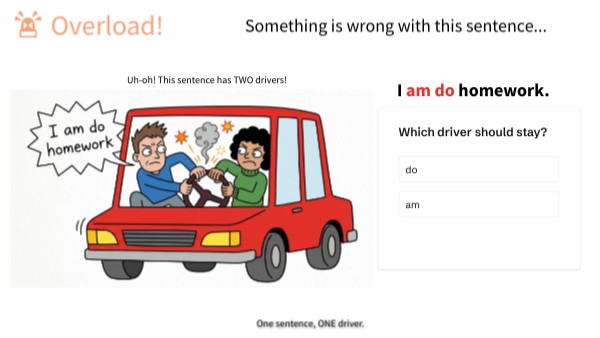
am is a be-verb, do is an action verb — both try to drive the same sentence. The learner must decide which one stays.
am 是 be 动词,do 是行为动词——两个都想驱动同一句话。学习者必须决定保留哪一个。
Learn the driver
认识驱动词
Learners meet the idea that every sentence has one driver: the verb. They see how be and action verbs play different roles.
学习者接触“每句只有一个驱动词”的概念,理解 be 动词与 行为 动词承担不同角色。
Recognise overload
识别超载
The module flags broken sentences such as “am do homework” and teaches learners to spot the moment a sentence has two drivers.
模块标出“am do homework”这类错误句子,教会学习者发现“一个句子有两个驱动词”的瞬间。
Decide which stays
决定保留谁
Learners choose which verb should stay to make the sentence grammatically correct, receiving immediate visual feedback.
学习者选择保留哪个动词使句子正确,并获得即时视觉反馈。
Build correct sentences
构建正确句子
After enough practice, learners assemble sentences that obey the “one driver” rule — turning recognition into production.
经过练习后,学习者组合出符合“单一驱动词”规则的句子——把识别能力转化为产出能力。
“Uh-oh! This sentence has TWO drivers! Something is wrong with this sentence…”
“哎呀!这个句子有两个驱动词!这个句子有问题……”
In-module feedback, Verb Kingdom Verb Kingdom 模块内反馈The module, screen by screen
逐屏走进这个模块
Verb Kingdom is a 15-page interactive module. The cards below reconstruct its real screen copy — the driver concept, the broken sentence, the decision, and the feedback — in the order a learner meets them.
Verb Kingdom 是一个 15 页的互动模块。下面这些卡片按其真实屏幕文案重构了核心体验——驱动词概念、错误句子、决策与反馈,按学习者遇到的顺序排列。
The module states its aim up front: recognise verb-to-be vs. verb-to-action, then build a correct sentence.
模块开篇点明目标:区分 be 动词与行为动词,然后构建正确句子。
Every sentence has a single driver — its verb. The metaphor gives learners something concrete to hold onto.
每句话只有一个驱动词——它的动词。这个隐喻给学习者一个具体可把握的概念。
am / is / are are be-verbs; run / eat / do are action verbs. Recognising which is which is the first skill.
am / is / are 是 be 动词;run / eat / do 是行为动词。先学会分辨它们。
A real broken sentence appears. The learner must find what is wrong.
出现一句真正错误的句子,学习者要找出问题所在。
The module flags the error in its own voice, then asks the learner to fix it.
模块用自己的语气指出错误,然后请学习者修正。
One verb must go. The learner decides, then sees correctly or incorrectly — and builds the fixed sentence.
必须去掉一个动词。学习者做出决定,看到“正确”或“错误”,并构建修正后的句子。
⌀ Reconstructed from the live module's real screen copy. The experience is a 15-page Genially interaction — these cards show its actual text in order, not pixel-perfect captures.
⌀ 依据在线模块真实屏幕文案重构。该体验为 15 页 Genially 互动内容——这些卡片按顺序展示其真实文字,而非逐像素截图。
Recognition → decision → feedback → rebuild
识别 → 决策 → 反馈 → 重建
Every screen runs the same tight loop. The learner recognises the problem, makes one decision, sees the consequence immediately, then rebuilds the sentence correctly.
每一屏都运行同一个紧凑循环:学习者识别问题、做出一个决策、立刻看到后果,然后重建正确句子。
Recognise
识别
Spot the be-verb and the action verb — the two drivers fighting over one sentence.
找出 be 动词与行为动词——争抢同一句话的两个驱动词。
Decide
决策
Choose which driver should stay. One tap, one decision per screen.
选择保留哪个驱动词。每屏一次点击、一个决策。
Feedback
反馈
Immediate consequence: correct, or “TWO drivers!” — never a dead end.
即时后果:正确,或“两个驱动词!”——从不是死胡同。
Rebuild
重建
Use the correct driver to build the sentence — recognition becomes production.
用正确的驱动词构建句子——识别转化为产出。
Game mechanics, not gimmicks: a light “Verb Kingdom” narrative, consequence-based feedback, and a safe replay loop make grammar practice feel like a challenge — not a worksheet.
游戏机制而非噱头:轻量的“Verb Kingdom”叙事、基于后果的反馈与安全的重玩循环,让语法练习像挑战而非练习册。
Interaction design, Verb Kingdom Verb Kingdom 交互设计One person, end to end
一个人,端到端
This was an independent end-to-end project — not a team exercise. I designed the learning architecture, the interaction model, and the visual system, then built, tested, and deployed the finished module myself.
这是一个独立的端到端项目——不是团队作业。我独立完成了学习架构、交互模型与视觉系统,然后自己构建、测试并部署了成品模块。
Instructional Design
教学设计
Driver metaphor, rule → example → practice.
驱动词隐喻,规则 → 例句 → 练习。
Interaction Design
交互设计
One decision per screen, consequence feedback.
每屏一个决策,基于后果的反馈。
Visual Design
视觉设计
Warm, playful system designed in Figma.
Figma 中设计的温暖、活泼视觉系统。
Development
开发
Interactive branching built in Genially + HTML/CSS/JS.
Genially + HTML/CSS/JS 构建分支交互。
Testing
测试
Flow, feedback, and failure recovery checked.
检查流程、反馈与失败恢复。
Deployment
部署
Published as a shareable URL.
发布为可分享链接。
Design
设计
- Learning architecture: driver metaphor, rule → example → practice
- 学习架构:驱动词隐喻,规则 → 例句 → 练习
- Visual system: warm, playful, not childish — designed in Figma
- 视觉系统:温暖、活泼但不幼稚 — Figma 设计
- Feedback design: instant, visual, consequence-based
- 反馈设计:即时、视觉化、基于后果
Development
开发
- Built in Genially for interactive branching and state
- Genially 构建 实现分支交互与状态
- Structured with HTML/CSS/JS for visual control and export
- HTML/CSS/JS 结构 便于视觉控制与导出
- Deployed as a shareable URL for self-directed access
- 部署为可分享链接 支持自主学习
One sentence, ONE driver.
be-verb / action-verb / fix it
Deliverables
交付物
- Interactive 15-page learning module (Genially) covering verb-to-be and verb-to-action15 页互动学习模块(Genially),覆盖 be 动词与行为动词
- Self-checked exercises with immediate visual feedback含即时视觉反馈的自查练习
- “One driver” visual metaphor and supporting examples across the module贯穿模块的“单一驱动词”视觉隐喻与配套例句
- Visual design system and asset library (Figma)视觉设计系统与素材库(Figma)
- Public, shareable deployment URL公开、可分享的部署链接
What this project demonstrates
这个项目体现了什么
Verb Kingdom is not just a grammar game. It demonstrates the full LXD / eLearning-developer loop — taking one specific learning problem and turning it into a self-contained, deployable digital learning experience.
Verb Kingdom 不只是一个语法游戏。它展示了完整的 LXD / eLearning 开发者闭环——把一个具体学习难点变成一个独立、可部署的数字学习体验。
Instructional Design
教学设计
A rule becomes a metaphor, then a decision, then a correct sentence.
规则变成隐喻,再变成决策,最后变成正确句子。
Interaction Design
交互设计
One decision per screen, immediate feedback, recoverable failure.
每屏一个决策、即时反馈、可恢复的失败。
Game-based Learning
游戏化学习
A light narrative turns practice into a self-directed challenge.
轻量叙事把练习变成自主挑战。
Rapid Prototyping
快速原型
From concept to playable module in a compact, iterative cycle.
在紧凑的迭代周期内,从概念到可玩模块。
Independent Development
独立开发
Concept, design, content, build and deployment — all done independently.
概念、设计、内容、构建与部署——全部独立完成。
Deployable Learning Experience
可部署的学习体验
A shareable URL that works on any device, with no teacher required.
可分享链接,任意设备可运行,无需教师。
Play Verb Kingdom
试玩 Verb Kingdom
Open the experience and see how a grammar rule becomes a problem to solve.
打开体验,看看一条语法规则如何变成一个待解决的问题。